
Universal Pipette Tips
Disposable pipette tips designed to fit single and multichannel pipettes from most manufacturers; offer acceptable performance compared to pipette specific tips and can be used with a variety of pipette models.
Single-use universal pipette tips are designed for compatibility with most mechanical and electronic single and multichannel pipettors.
Universal pipette tips are available in a range of types, sizes, colors, styles, and packaging configurations and may be designed for specific purposes or tasks.
- Capacity or volume based on the pipettor size
- Filters to reduce contamination and cross-contamination
- Color
- Sterility or autoclavability
- Tip style: beveled, tapered, wide bore, round, flat, or gel-loading
- Length: short or extended
- Purity: metal-free or DNase-, RNase-, ATP-, Bioburden-, PCR inhibitor-, endotoxin-, or pyrogen-free for genomic and biologic applications
- Surface treatments to reduce retention
- Packaging options to help facilitate re-stocking or eliminate waste

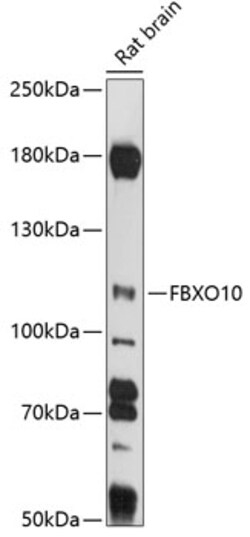
ABclonal Technology FBXO10 Rabbit pAb

Members of the F-box protein family, such as FBXO10, are characterized by an approximately 40-amino acid F-box motif. SCF complexes, formed by SKP1 (MIM 601434), cullin (see CUL1, MIM 603134), and F-box proteins, act as protein-ubiquitin ligases. F-box proteins interact with SKP1 through the F box, and they interact with ubiquitination targets through other protein interaction domains (Jin et al., 2004 [PubMed 15520277]).

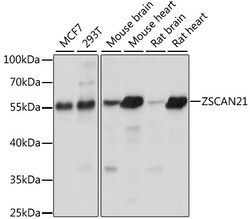
ABclonal Technology ZSCAN21 Rabbit pAb
Enables DNA-binding transcription activator activity, RNA polymerase II-specific and RNA polymerase II cis-regulatory region sequence-specific DNA binding activity. Involved in positive regulation of transcription by RNA polymerase II. Predicted to be located in nucleus.
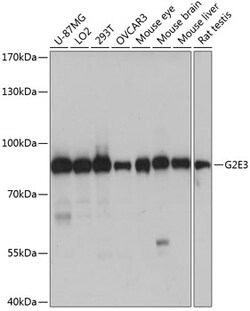
ABclonal Technology G2E3 Rabbit pAb
Predicted to enable ubiquitin protein ligase activity. Predicted to be involved in apoptotic process and protein ubiquitination. Predicted to act upstream of or within blastocyst development, negative regulation of intrinsic apoptotic signaling pathway, and protein polyubiquitination. Located in Golgi apparatus and cytosol.
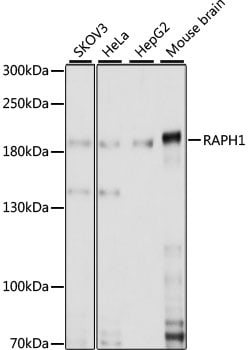
ABclonal Technology RAPH1 Rabbit pAb
This gene encodes a protein that belongs to the Mig10/Rap1-interacting adaptor molecule/Lamellipodin family of adapter proteins, which function in cell migration. Members of this family contain pleckstrin-homology domains, Ras-association domains, and proline-rich C-termini. The protein encoded by this gene regulates actin dynamics through interaction with Ena/Vasodilator proteins as well as direct binding to filamentous actin to regulate actin network assembly. Alternative splicing results in multiple transcript variants.
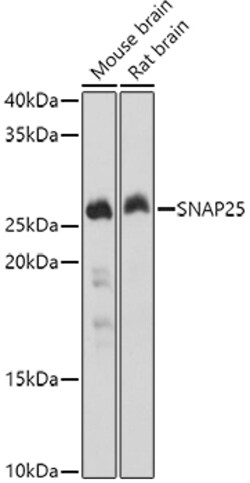
ABclonal Technology SNAP25 Rabbit pAb
Synaptic vesicle membrane docking and fusion is mediated by SNAREs (soluble N-ethylmaleimide-sensitive factor attachment protein receptors) located on the vesicle membrane (v-SNAREs) and the target membrane (t-SNAREs). The assembled v-SNARE/t-SNARE complex consists of a bundle of four helices, one of which is supplied by v-SNARE and the other three by t-SNARE. For t-SNAREs on the plasma membrane, the protein syntaxin supplies one helix and the protein encoded by this gene contributes the other two. Therefore, this gene product is a presynaptic plasma membrane protein involved in the regulation of neurotransmitter release. Two alternative transcript variants encoding different protein isoforms have been described for this gene.
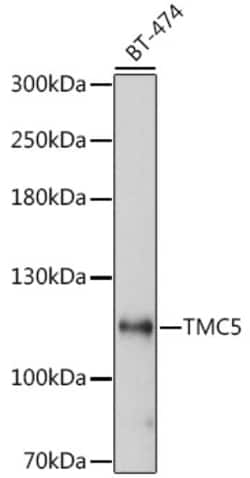
ABclonal Technology TMC5 Rabbit pAb
Predicted to enable mechanosensitive ion channel activity. Predicted to be involved in ion transmembrane transport. Located in extracellular exosome.
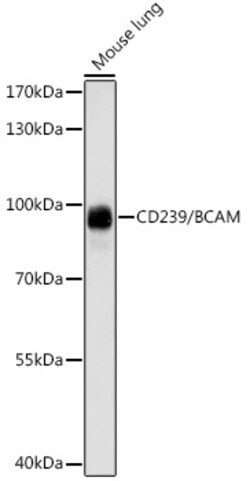
ABclonal Technology CD239/BCAM Rabbit pAb
This gene encodes Lutheran blood group glycoprotein, a member of the immunoglobulin superfamily and a receptor for the extracellular matrix protein, laminin. The protein contains five extracellular immunoglobulin domains, a single transmembrane domain, and a short C-terminal cytoplasmic tail. This protein may play a role in epithelial cell cancer and in vaso-occlusion of red blood cells in sickle cell disease. Polymorphisms in this gene define some of the antigens in the Lutheran system and also the Auberger system. Inactivating variants of this gene result in the recessive Lutheran null phenotype, Lu(a-b-), of the Lutheran blood group. Two transcript variants encoding different isoforms have been found for this gene.
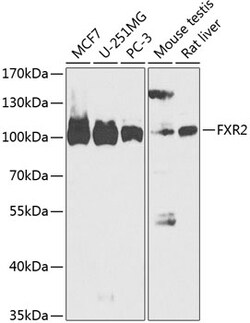
ABclonal Technology FXR2 Rabbit pAb
The protein encoded by this gene is a RNA binding protein containing two KH domains and one RCG box, which is similar to FMRP and FXR1. It associates with polyribosomes, predominantly with 60S large ribosomal subunits. This encoded protein may self-associate or interact with FMRP and FXR1. It may have a role in the development of fragile X cognitive disability syndrome.
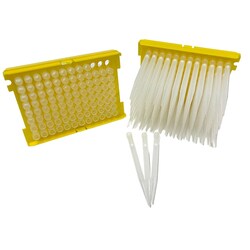
Revvity Health Sciences Inc Pipette Filter tips, clear, 900 µL, Pre-sterilized, 960/PK
Pipette Filter tips, clear, 900 µL, Pre-sterilized, 960/PK

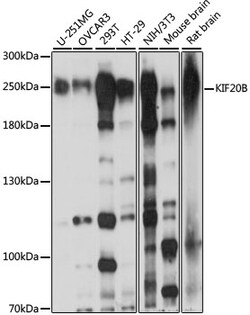
ABclonal Technology KIF20B Rabbit pAb
Enables several functions, including WW domain binding activity, plus-end-directed microtubule motor activity, and protein homodimerization activity. Involved in positive regulation of cell population proliferation and positive regulation of cytokinesis. Located in several cellular components, including microtubule cytoskeleton, midbody, and nuclear lumen.
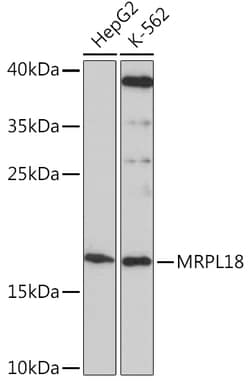
ABclonal Technology MRPL18 Rabbit pAb
This nuclear gene encodes a protein component of the larger 39S subunit of mitochondrial ribosome. This protein may also aid in the import of nuclear-encoded 5S rRNA into mitochondria. Alternative splicing results in multiple transcript variants, most of which are not predicted to encode a protein. A pseudogene of this gene is found on chromosome 16.
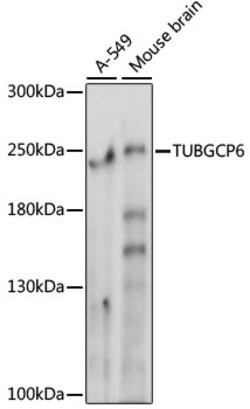
ABclonal Technology TUBGCP6 Rabbit pAb
The protein encoded by this gene is part of a large multisubunit complex required for microtubule nucleation at the centrosome.
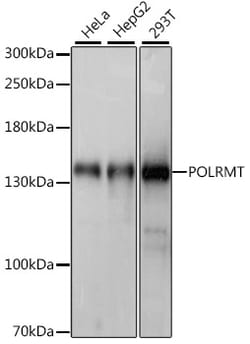
ABclonal Technology POLRMT Rabbit pAb
This gene encodes a mitochondrial DNA-directed RNA polymerase. The gene product is responsible for mitochondrial gene expression as well as for providing RNA primers for initiation of replication of the mitochondrial genome. Although this polypeptide has the same function as the three nuclear DNA-directed RNA polymerases, it is more closely related to RNA polymerases of phage and mitochondrial polymerases of lower eukaryotes.

Thomas Scientific 1000 l XL Sharp Elite Barrier Tips Racked Sterile
1000 l XL Sharp Elite Barrier Tips Racked Sterile
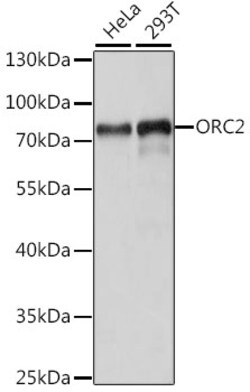
ABclonal Technology ORC2 Rabbit pAb
The origin recognition complex (ORC) is a highly conserved six subunits protein complex essential for the initiation of the DNA replication in eukaryotic cells. Studies in yeast demonstrated that ORC binds specifically to origins of replication and serves as a platform for the assembly of additional initiation factors such as Cdc6 and Mcm proteins. The protein encoded by this gene is a subunit of the ORC complex. This protein forms a core complex with ORC3, -4, and -5. It also interacts with CDC45 and MCM10, which are proteins known to be important for the initiation of DNA replication. This protein has been demonstrated to specifically associate with the origin of replication of Epstein-Barr virus in human cells, and is thought to be required for DNA replication from viral origin of replication. Alternatively spliced transcript variants have been found, one of which is a nonsense-mediated mRNA decay candidate.